
The Invisible Crisis Behind Dull, Tight, and Unhappy Skin
Have you ever applied a rich, heavy moisturizer to your face, only to feel your skin tightening up and crying out for help again just an hour later? Or perhaps you have noticed fine, paper-thin crinkles appearing on your cheeks when you smile, even though you don’t consider yourself old enough to have deep wrinkles? If this sounds familiar, your skin isn’t necessarily dry – it is likely experiencing a silent, invisible crisis known as deep tissue dehydration.
As a licensed esthetician, I see this exact scenario play out on my treatment table day after day. Clients come to me frustrated, bringing bags full of heavy facial oils, rich overnight balms, and intensive creams, wondering why their skin still looks dull, behaves sensitively, and flakes under their makeup. My diagnosis is almost always the same: “Your skin barrier is desperately thirsty for water, but you are trying to feed it oil.”
To fix this, you don’t need a heavier cream. You need to understand the fundamental difference between skin that lacks oil (dry skin) and skin that lacks water (dehydrated skin). Most importantly, you need a high-performance, medical-grade delivery system that can bypass the surface of your skin and flood the deeper epidermal layers with bio-available moisture. In this ultimate guide, we will unpack the precise science of skin hydration, expose the common formulation traps of standard hyaluronic acid products, and explore why the Christina Line Repair Theraskin + HA serum is the absolute holy grail hydration treatment I prescribe to every single client who walks through my doors.
The Hydration Blueprint: Dry vs. Dehydrated Skin
To properly treat your skin, we must first clear up one of the biggest misconceptions in modern skincare. People routinely use the terms “dry” and “dehydrated” interchangeably, but from a clinical esthetics perspective, they represent two completely different biological states.
Dry Skin (A Skin Type)
- What it is: Dry skin is a genetic skin type that you are born with. Your body naturally produces very little sebum (oil).
- The Problem: It lacks the necessary lipids and oils to coat the surface of the skin and prevent moisture loss.
- How it feels: It feels consistently rough, has almost invisible pores, rarely experiences acne breakouts, and looks matte or flaky all over the face, regardless of the season.
- The Cure: It requires lipid-rich creams, plant oils, and ceramides to rebuild its missing lipid coat.
Dehydrated Skin (A Skin Condition)
- What it is: Dehydrated skin is a temporary skin condition that can affect absolutely any skin type—including ultra-oily, acne-prone skin.
- The Problem: Your skin cells lack water content in the stratum corneum (the outermost layer of the epidermis).
- How it feels: It feels tight, looks dull or paper-like, shows fine “dehydration lines,” and often overcompensates for the lack of water by producing more oil, leading to a confusing mix of an oily surface with deep internal tightness.
- The Cure: It requires water-binding humectants, specifically optimized hyaluronic acid, that can penetrate deeply without adding heavy, pore-clogging oils.
The Dark Side of Hyaluronic Acid: Why Your Current Serum is Drying You Out
If you look around the beauty industry today, almost every brand has a hyaluronic acid (HA) serum on the shelf. It has become the darling ingredient of the skincare world, famous for its ability to hold up to 1000 times its weight in water. But here is the secret your esthetician knows that drugstore brands won’t tell you: not all hyaluronic acid molecules are created equal, and the wrong formula can actually make your skin significantly more dehydrated.
To understand why, we have to look at molecular weight. Hyaluronic acid naturally exists as a very large molecule. If a skincare brand uses raw, unrefined high-molecular-weight HA, those massive molecules are simply too big to slip past your skin’s protective top barrier. They sit directly on top of your face like a film.
If you live in a dry climate (like an air-conditioned room or a desert environment), that surface film of hyaluronic acid needs water to bind to. Since there is no moisture in the dry air around you, the molecule does something destructive: it pulls water upward out of the deeper layers of your own skin to satisfy itself. It evaporates into the air, leaving your deeper tissues drier, tighter, and more compromised than they were before.
To prevent this phenomenon, a professional-grade formulation must utilize advanced cross-linked, encapsulated, and multi-weight hyaluronic acid molecules. These micro-sized elements are engineered to dive deep into the cellular levels, releasing hydration from the inside out while reinforcing the skin’s moisture barrier on the surface.
Esthetician’s Warning: Telltale Signs of an Impaired Moisture Barrier
When skin remains chronically dehydrated for too long, it triggers a dangerous domino effect that breaks down your skin’s defense system. As an esthetician, I am constantly watching for these warning signs that indicate a client’s moisture barrier is actively failing:
- The “Sponge Effect” Disappearance: When you apply your moisturizer, does your skin swallow it instantly within seconds, yet still feel utterly dry and tight immediately afterward? This means your skin cells are completely depleted of water, behaving like a brittle, dry kitchen sponge that cannot hold its shape.
- Sudden Sensitivity and Burning: If products that used to feel completely fine – like your favorite gentle wash or basic daily lotion – suddenly cause a stinging, burning, or itching sensation upon application, your protective barrier has developed microscopic cracks due to lack of hydration.
- The Compulsive Oily Sheen: If your skin looks highly shiny, slick, and greasy by lunchtime, yet underneath that layer of oil you feel a deep, uncomfortable physical tightness, your skin is screaming for water. It is producing excess sebum as an emergency mechanism to seal in whatever tiny drop of water it has left.
The Clinical Solution: Christina Line Repair Theraskin + HA
When clients present with stubborn dehydration, I do not experiment. I immediately put them on a regimen centered around the Christina Line Repair Theraskin + HA. This is not just another hydrating fluid; it is an iconic, clinical-grade formulation by Christina Cosmeceuticals that has been celebrated by professionals globally for its unparalleled ability to transform compromised, thirsty skin.
Theraskin utilizes an advanced, bio-engineered delivery system that addresses the exact molecular weight issues we discussed earlier. It combines multiple weights of hyaluronic acid that work in perfect harmony across different depths of the skin.
The Power of Encapsulated Hyaluronic Acid
The crown jewel of this formulation is its utilization of encapsulated hyaluronic acid. Through high-tech processing, the HA molecules are housed within specialized, microscopic spheres that slowly dissolve as they journey through the skin layers. This ensures a controlled, continuous, timed-release of deep hydration over many hours, rather than a fleeting blast of moisture that disappears shortly after application.
Key Active Ingredients Inside this Formulation:
- Advanced Hyaluronic Acid Matrix: A precise blend of multi-molecular weights that target both surface moisture retention and deep-tissue cellular hydration, visibly plumping the skin and erasing fine dehydration lines.
- Alizaria Extract: A specialized botanical ingredient that possesses potent anti-inflammatory properties, working behind the scenes to soothe redness and protect the newly hydrated skin from environmental aggressors.
- NMF (Natural Moisturizing Factors) Mimics: Elements that perfectly replicate the skin’s own natural moisture blend, helping to instantly repair a cracked skin barrier and prevent trans-epidermal water loss (TEWL).
The Textural Experience and Real-World Results
Theraskin is a sensory dream. Unlike many commercial HA serums that feel sticky, tacky, or leave a weird, glue-like residue that pills under your makeup, Theraskin has a silky, water-light fluid texture. It glides across the skin like liquid silk and absorbs beautifully within seconds, leaving behind zero weight—just an immediate, visible “bounce” and a healthy, plump texture.
Within just a few days of implementing Theraskin into your routine, the chronic morning tightness begins to vanish. Your skin retains its moisture all day long, texture becomes noticeably smoother, and that elusive, coveted “lit-from-within” professional glow completely returns to your complexion.
The Professional Hydration Protocol: How to Layer Your Serum
To get 100% of the benefits from your Christina Line Repair Theraskin + HA, you must apply it using professional layering principles. As a licensed esthetician, here is the exact protocol I teach my clients to use at home:
- Step 1: The Damp Skin Rule (Crucial): Never apply a hyaluronic acid serum onto bone-dry skin. After cleansing, leave your face slightly damp with water, or better yet, mist your skin generously with a professional, alcohol-free hydrating toner. This gives the HA molecules a ready-made pool of external water to grab onto.
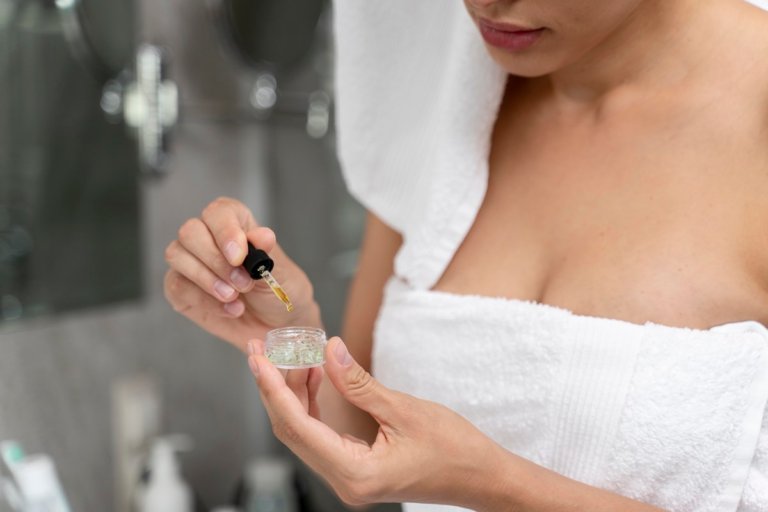
- Step 2: The Application Technique: Dispense 3 to 4 drops of Theraskin onto your fingertips. Do not rub your palms together to warm it up – let the product stay on your fingertips where it belongs. Press and pat the serum directly into your damp face, neck, and chest. Focus heavily on areas prone to dehydration lines, like the cheeks and around the mouth.
- Step 3: The Immediate Seal: Do not wait for the serum to fully dry down or make your skin feel tight. Within 60 seconds of patting it in, while your face still feels plump and moist, apply your daily moisturizer or daytime SPF over it. Your moisturizer acts as a physical shield, locking the hyaluronic acid molecules into the deeper skin layers and preventing the moisture from evaporating into the air.
Lifestyle Factors that Steal Your Skin’s Water
While topical application of a professional serum like Theraskin is your strongest weapon, you must also defend your skin against the lifestyle factors that constantly deplete your body’s water reserves.
Air Conditioning and Artificial Heating
Central heating and cooling systems are notorious moisture thieves. They scrub the air of all humidity, creating a harsh environment that aggressively pulls water out of your skin barrier through trans-epidermal water loss. To combat this, keep a humidifier running in your bedroom while you sleep to maintain an optimal 40% to 50% air humidity level.
Over-Exfoliation with Acids and Retinoids
In the pursuit of smooth skin, many people over-use glycolic acids, salicylic pads, and strong retinols every single night. This constant chemical assault strips away your skin’s natural lipid barrier, leaving the underlying tissue exposed and unable to retain water. If your skin is dehydrated, pause your active acids for two weeks and focus purely on flooding the skin with Theraskin and barrier-repairing topicals.
Conclusion: The Foundation of Radiant Skin is Water
When it comes down to it, every single cellular process within your skin requires water to function properly. When your skin is deeply hydrated, it can heal from acne faster, produce collagen more efficiently, resist environmental aging, and maintain a calm, radiant, redness-free appearance.
Investing in a high-performance, clinically proven delivery system like the Christina Line Repair Theraskin + HA isn’t an extra luxury step – it is the foundational building block of your entire skincare journey. By feeding your skin the specific molecular hydration it craves and locking it in correctly, you will unlock a level of plumpness, clarity, and true skin health that no heavy cream could ever deliver.